Showing posts with label parallelogram. Show all posts

Monday, April 19, 2010

Area

Today, we took our Geometry Formulas Gateway. When I was studying for it before class, it seemed a little overwhelming to try and memorize all of the formulas. Most of the time, I found it easier to break up a figure into several parts to try and calculate its area or volume. Personally, I think it is easy to find the perimeter of a figure. All that you need to do is add up the lengths of each side. The perimeter of a circle, however, is just finding the circumference.

Finding the area of a rectangle and square are easy. All you have to do is multiply length and width to get the area. Calculating the area of a parallelogram is easy to understand when it is broken up. The picture below explains the process.
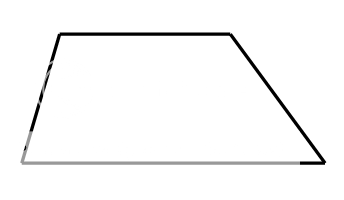
A trapezoid is a little different. An easier way to look at finding the area is duplicating the trapezoid and then rotating it to make a parallelogram as the picture shows below. Since you only need the area of one trapezoid, you multiply the area of the parallelogram that you formed by 1/2 to give you the area of just one.
Finding the area of a triangle can be easier understood if you duplicate it and then fit it together with the other to form a parallelogram. It is basically the same concept used to find the area of a trapezoid as discussed above. If you are trying to find the area of a right triangle, duplicating it and then fitting it together with the other will form a rectangle.
The easiest way to find the area of a circle is to just memorize the formula.
I found a website that goes over area formulas that may also be of some help.

Saturday, April 17, 2010

Triangles and Quadrilaterals

There are certain triangles and quadrilaterals that occur often enough to be given special names. Sometimes I get some of the terminology confused, so I thought I could dedicate one of my posts to explaining what each of them mean.
Let's first start with triangles (three-sided polygons). An acute triangle is when all three angles within the triangle are acute (less than 90 degrees, but more than 0). A right triangle contains one right angle (90 degrees). An equilateral triangle is a triangle that has all three sides of equal length. A scalene triangle is a triangle that has three sides of different length. An isosceles triangle has at least two sides of equal length. Lastly, an obtuse triangle has one angle that is obtuse (greater than 90 degrees, but less than 180 degrees).
Now, I am going to go over quadrilaterals (four-sided polygons). A trapezoid has exactly one pair of opposite sides that are parallel. An isosceles trapezoid is a trapezoid in which its non-parallel sides are congruent. A rhombus has opposite sides that are parallel and all sides have equal length. A parallelogram has pairs of opposite sides that are parallel and of equal length. A rectangle has pairs of opposite sides that are parallel and of equal length, and contains all right angles. Lastly, a square has all sides of equal length and contains all right angles.
Hopefully, this helped a little bit with trying to figure out what makes each of them different from each other. I also found a game that relates to triangles and quadrilaterals.